Spider Solitaire Deluxe® 2
- 3.7
- Rating
- 1.00M
- Installs
- Free
- Price

 Analysis by App-foxy
I spent time with Spider Solitaire Deluxe® 2 as a straightforward card game for short breaks, and its appeal is easy to understand: it takes the familiar Spider Solitaire format and keeps the focus on arranging cards, clearing the table, and making better decisions with each deal. It is developed by Murka Games Limited, belongs to the card-game category, and can be downloaded for free. That makes it easy to try without committing money first, although optional purchases change the value question for players who want to spend inside the game.
My overall impression is that this is best viewed as a convenient solo puzzle rather than a deep card-gaming platform. It works well when I want something quiet and repeatable, especially when I have only a few minutes. At the same time, anyone expecting a large collection of modes, a social experience, or a completely distraction-free classic solitaire app may find the package less convincing. The important question is not whether Spider Solitaire itself is enjoyable; it is whether this particular version gives you enough comfort and replay value to justify keeping it installed.
How the free model affects the value
The basic entry point is clear: the game is free, so I can install it and decide whether the presentation and play style suit me before paying anything. That is a useful advantage for a card game because preferences are personal. Some players want a bare table and fast deals, while others appreciate a more polished mobile presentation. Trying it first removes much of that initial risk.
You May Also Like

 Blood Strike: 2.5 Anniversary
Blood Strike’s Loadouts Turn Every Drop Into a Tactical Gamble
A close look at Blood Strike’s custom loadouts: how fast access to signature weapons reshapes its battle royale rhythm, rewards preparation, and narrows the gap between fights.

 Pandora - Music & Podcasts
Pandora’s Music Is Easy to Start, but Harder to Recover
Pandora’s strength is its low-effort path from a seed to a station. Its weak spot is how much confidence it asks you to place in connection, setup, and quiet recovery.

 8 Ball Pool
 Is Built on Rivalries, Rematches, and Routine
A close look at the rivalries, rematches, shared routines, and unanswered safety questions that turn a quick pool match into a persistent mobile community.

 Samsung Music
’s Quiet Strength Is Playing What You Already Own
Its reach comes less from spectacle than from dependable access to a personal library. That simplicity is both the app’s strongest retention engine and its ceiling.

 AccuWeather: Weather Radar
AccuWeather Review: A Quick, Clear Forecast for Everyday Decisions
For everyday plans, the best forecast is the one you can understand quickly. AccuWeather makes rain timing, radar, and local conditions easy to act on, with a few trade-offs.

 Hill Climb Racing
Why Hill Climb Racing Still Turns Crashes Into One More Run
A tiny car, a bumpy hill and one more upgrade: Hill Climb Racing keeps resurfacing because its simple chaos makes every near-miss feel personal.
More From Our News Desk



There are in-app purchases priced from $4.99 to $49.99 per item. I would treat those as optional spending rather than part of the admission price. In practical terms, the free download gives the game a chance to prove its everyday usefulness, while the purchase range means frequent players should decide in advance how much, if anything, the experience is worth to them. I would not spend simply because a purchase is available; I would first check whether the free experience already covers my needs.
That distinction matters with solitaire. The core activity is familiar and can be found in many free alternatives, including simple versions that place fewer demands on the player’s attention outside the card layout. Spider Solitaire Deluxe® 2 therefore has to earn its place through the way it feels to play: readable cards, comfortable controls, sensible pacing, and a presentation I actually enjoy returning to. A free download is good value for testing those things, but it does not automatically make every optional purchase good value.
I also like to separate “free to start” from “free for every kind of player.” Someone who only wants occasional rounds may receive plenty of value without paying. A player who spends long sessions with solitaire may be more sensitive to interruptions, progression pressure, or any purchase prompts that appear during normal use. Since spending is optional, my advice is simple: use the game naturally for several sessions, notice what affects your concentration, and only then decide whether an upgrade or item is worthwhile.
What the card table offers in practice
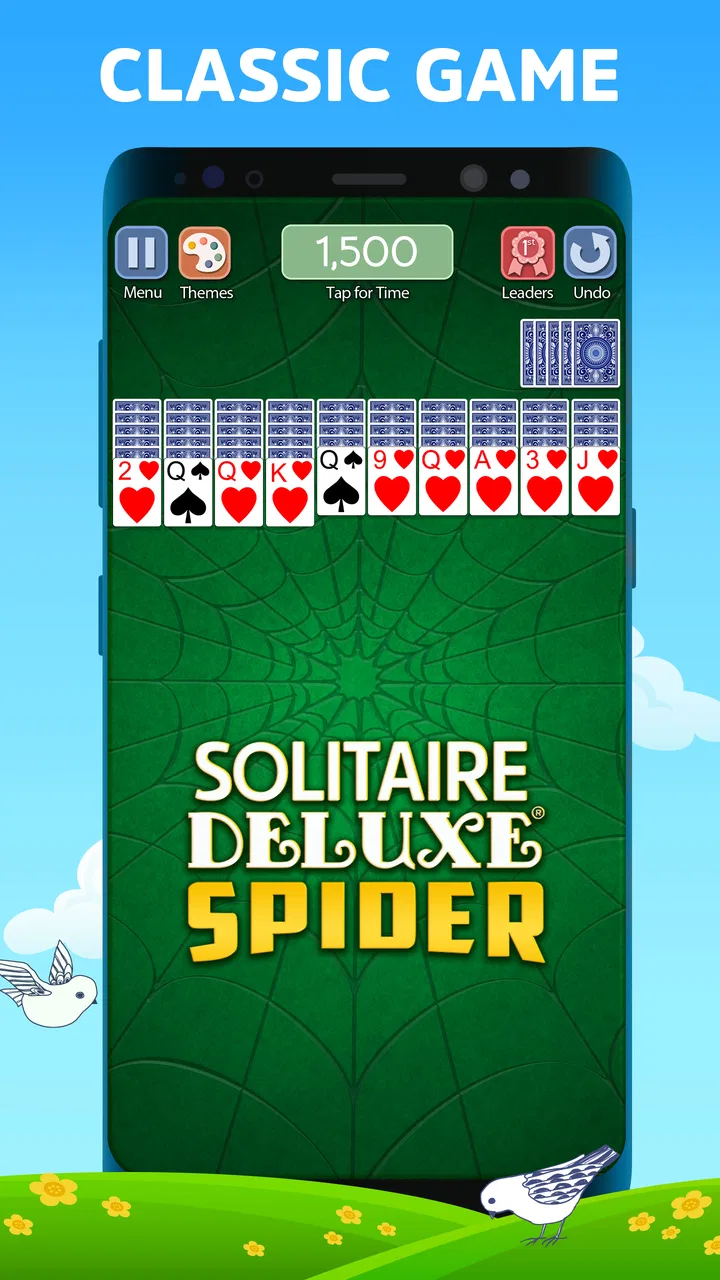
Spider Solitaire is more demanding than the simplest single-suit solitaire formats because the player has to think about sequences, blocked cards, and the timing of empty spaces. I found that the best rounds are not about moving cards quickly. They are about preserving flexibility. A move that looks productive can leave a useful card buried, while a slower arrangement can open several paths later.
That gives the game a pleasant middle ground. It is easy to understand if you already know solitaire, but it still asks for planning rather than reflexes. I can play casually while waiting for an appointment, or I can pay closer attention and treat a difficult layout as a small logic problem. This flexibility is one of the strongest reasons to consider it over a purely automatic time-filler.
My most useful habit was to pause before every major sequence move and ask what it exposes. Moving a long run may create an empty column, but it can also remove the only temporary home for an awkward card. I found better results by protecting open columns, building descending runs when possible, and avoiding moves that reduce my future choices merely because they look tidy in the moment.
Another practical tip is to use the undo option, when available in the current play session, as a learning tool rather than a way to erase every mistake immediately. I like testing one branch, seeing which card becomes trapped, and then reversing the move to compare another route. That approach turns a lost deal into a lesson about sequencing. It is particularly helpful for players who know the rules but still struggle to see several moves ahead.
There is also a useful difference between playing to finish and playing to improve. If I am taking a quick break, I may accept a safe move that keeps the board manageable. When I have more time, I can aim for cleaner planning and examine why a deal became difficult. This makes the same game feel different depending on my mood, without requiring a separate mode or a more complicated ruleset.
Small habits that make short sessions better
A realistic use case is a ten-minute wait before a train or an appointment. I can begin a deal, make a few deliberate moves, and stop without needing to coordinate with another player. The game suits that kind of interruption because the challenge is self-contained. I do not have to maintain a team, respond to an opponent, or remember a long story. When the wait ends, the decision-making has still given my attention something useful to do.
For that situation, I recommend avoiding rushed opening moves. The first few cards often determine whether the rest of the layout remains flexible. I look for moves that reveal hidden cards or create room without prematurely locking a sequence. If I am interrupted, I also prefer leaving the table in a state where the next obvious decision is easy to identify rather than scattering several possible moves across the board.
For a longer session at home, I would use a different approach. Instead of repeating moves quickly after a failure, I would identify the first point where the layout became restricted. Was an empty column used too early? Did I build a sequence that prevented access to a buried card? Did I draw from the stock before exhausting useful open moves? Reviewing that moment helps more than simply starting another deal and hoping for a better result.
These habits are not flashy features, but they are where the game’s value becomes more tangible. The app can function as a light concentration exercise because it rewards patience and forward planning. I would not describe it as a substitute for structured brain training, and I would not expect every deal to feel equally satisfying. Still, the card layout gives short sessions more substance than an entirely passive distraction.
Where it compares well with other solitaire choices
Compared with a very basic solitaire app, this version is likely to appeal more to someone who wants the Spider format specifically rather than a broad collection of unrelated card games. The focus can be a benefit: I do not need to search through several rule sets before starting the kind of puzzle I came for. Players who enjoy building and reorganizing descending sequences may prefer that concentration over a more general solitaire bundle.
Compared with a physical deck, the mobile version is much more convenient. I do not need a table, I cannot accidentally knock over the layout, and I can begin immediately. The trade-off is that a phone screen may feel less relaxing than real cards for people who enjoy the tactile part of solitaire. A physical deck also avoids the question of optional digital purchases entirely, though it is less practical during a commute or a short waiting period.
Compared with competitive card games, the experience is calmer and more private. There is no pressure from another person’s turn, no need to maintain a connection with a group, and no social obligation to keep playing. That is exactly why I would recommend it to someone who wants a quiet puzzle. On the other hand, players who need competition, conversation, or changing opponents will probably get bored sooner than they would with an online multiplayer card title.
Compared with minimalist solitaire apps, the choice comes down to priorities. If I want the fewest possible distractions and the fastest route to a deal, a stripped-down alternative may be better. If I prefer a more recognizable mobile game package and enjoy returning to the same Spider-style challenge, Murka Games Limited’s offering has a stronger reason to remain on my phone. The free access makes that comparison easy to test rather than forcing a blind purchase.
Limitations I would consider before installing
The first limitation is repetition. Spider Solitaire has a focused loop, and focus is both its strength and its boundary. After several rounds, I may feel that I am solving variations of the same type of problem. That is not a flaw for a dedicated solitaire fan, but it is a warning for anyone who needs constant novelty. A broader card collection would be a better fit for players who quickly move between different rules.
The second limitation is the tension between a free game and optional spending. I appreciate being able to start without paying, but I would remain alert to how purchase prompts affect the rhythm of play. Even a well-designed solitaire game loses some of its calm if I feel pushed toward a transaction while I am trying to concentrate. My personal rule is to judge the unpaid experience on its own before considering anything in the purchase range.
The third limitation is that a card game does not automatically become a complete mental-training program. The planning involved can be satisfying, and it may encourage patience, but I would not install this expecting lessons, progress reports, or a structured curriculum. Its value is in the act of playing. If you want guided exercises or measurable training goals, a dedicated learning app may be a better choice.
Device compatibility is fairly approachable for an older Android phone because the game requires Android 6.0 or later. That broadens its usefulness for people who are not using a recent handset. The current version is 4.84.1, so I would still keep the app updated through the normal store process when possible, especially if a particular device behaves differently from another. I would not choose a game solely on version number, but compatibility can decide whether a casual installation is practical.
The age rating is Everyone, which matches the simple, non-competitive nature of the card activity. I would feel comfortable recommending it as a general-audience pastime, while still explaining to younger players that the game rewards patience more than speed. For families, the main conversation is likely to be about screen time and optional spending rather than the card rules themselves.
Who is most likely to get lasting value
I think the strongest audience is the person who already enjoys Spider Solitaire and wants a convenient mobile table. The game gives that player a familiar reason to return, and the free starting point makes it easy to compare the feel with other versions. It also suits people who like quiet, solo puzzles that can be paused mentally between everyday tasks.
It is a good match for anyone trying to replace mindless scrolling with a small decision-making activity. I would not oversell that benefit, but choosing a sequence and protecting future moves does require more attention than simply watching short videos. The best results come when the player treats each deal as a compact puzzle rather than tapping randomly until the layout collapses.
It may also work for older devices that meet the Android requirement and for users who do not want a demanding action game. The card format is gentle on the hands and does not depend on rapid reactions. Someone with a few minutes to spare can play at a comfortable pace, then return to the rest of the day without needing to remember a complicated control scheme.
I would recommend skipping it if your main goal is social play, a large variety of card rules, or a completely minimal interface. I would also skip optional purchases unless the free experience has already become a regular part of your routine and you understand exactly what you are paying for. A different solitaire app may serve you better if you dislike any extra presentation around the table or want a one-time paid product instead of a free download with in-app items.
The game’s audience size suggests that it has reached a substantial mobile player base, with over one million installs and around twelve thousand ratings. Its average rating is 3.7, while roughly two thousand four hundred written reviews provide a broader sense of how people have responded. I see those figures as a reason to investigate rather than a guarantee: the rating is respectable but not exceptional, so personal tolerance for the game’s trade-offs matters more than popularity alone.
My verdict on installing and spending
My recommendation is to try Spider Solitaire Deluxe® 2 if you want a free, focused Spider Solitaire experience for Android and value convenience over variety. The unpaid entry point is the clearest part of the value proposition: you can see whether the layout, pacing, and overall feel fit your routine before deciding whether the game deserves more of your time or money.
I would keep my expectations narrow. This is not the choice I would make for multiplayer competition, a large card-game collection, or a fully structured training system. I would choose it for quiet solo play, especially during short waits or at the end of a busy day when I want a puzzle that is easy to start and difficult enough to hold my attention.
The purchase range from $4.99 to $49.99 per item makes restraint important. Free access already lets casual players test the central experience, so paying should be a deliberate decision based on personal use rather than impulse. If the basic game becomes a dependable part of your routine and the optional content genuinely improves that routine for you, spending may feel reasonable. If not, there is no need to turn a simple card pastime into a larger expense.
In the end, I see this as a sensible try-before-you-decide card game. Its strongest qualities are the portable Spider format, the calm solo rhythm, and the planning that makes even a short session feel purposeful. Its weaknesses are the narrow scope, possible friction around optional purchases, and the fact that solitaire fans can find many competing versions. For the right player, that focused design is enough. For everyone else, the free download makes finding out relatively easy.
FAQs for Spider Solitaire Deluxe® 2
01What is Spider Solitaire Deluxe® 2 and how does it differ from the classic version?
Spider Solitaire Deluxe® 2 is an enhanced version of the classic solitaire game that offers updated graphics, multiple themes, and customizable options. Unlike the traditional version, this app includes daily challenges, achievements, and the ability to track your stats, making it both engaging and rewarding for players seeking a more modern solitaire experience.
02Is Spider Solitaire Deluxe® 2 free to download and play?
Yes, Spider Solitaire Deluxe® 2 is free to download and play. However, the app offers in-app purchases that provide additional features and remove ads. These purchases are optional, allowing users to enjoy the basic version without any cost or to enhance their gameplay with premium options.
03What platforms support Spider Solitaire Deluxe® 2?
Spider Solitaire Deluxe® 2 is available for both Android and iOS devices. It supports a wide range of smartphones and tablets, ensuring that players can enjoy the game on their preferred platform. Make sure your device meets the minimum operating system requirements for optimal performance.
04Can I play Spider Solitaire Deluxe® 2 offline?
Yes, Spider Solitaire Deluxe® 2 can be played offline. This feature is particularly convenient for users who want to enjoy the game without an internet connection. However, some features, such as daily challenges and leaderboard updates, may require an internet connection to function properly.
05How does Spider Solitaire Deluxe® 2 enhance the user experience with its features?
Spider Solitaire Deluxe® 2 enhances user experience by offering customizable themes and card designs, along with smooth animations and intuitive controls. It also provides helpful hints and undo options, catering to both beginners and seasoned players. The inclusion of daily challenges and achievements adds an extra layer of excitement and engagement.
Pros
- Intuitive interface enhances gameplay experience.
- Customizable themes and card backs available.
- Daily challenges keep the game engaging.
- Offline play supported for uninterrupted fun.
- User-friendly hints and undo options.
Cons
- Ads can be intrusive during gameplay.
- Limited free themes without in-app purchases.
- Occasional lag on older devices.
- Requires significant storage space.
- No multiplayer option available.

Spider Solitaire Deluxe® 2
Gallery